

Do you need crampons and ropes for the Rwenzori? An expert guide will cover every route from the Central Circuit to Margherita Peak. Know exactly what gear to bring.
It is one of the most practically important questions anyone planning a Rwenzori trek can ask, and it is also one of the most commonly misunderstood. During the planning process, the question of whether crampons and ropes are necessary for the Rwenzori becomes clear, especially after viewing footage of ice-draped ridges or reading a trip report from a trekker who successfully reached Mount Stanley’s glaciers. The answer, like most things about these extraordinary mountains, is nuanced. It depends on where you are going, which route you are taking, and what your ultimate objective is.
In summary, most Rwenzori trekkers who complete the Central Circuit Trail, the Kilembe Trail, the Bukulungu Trail, or the Mahoma Loop without the summit of Mount Stanley do not require crampons or technical rope work. The trails, while demanding, are non-technical in the mountaineering sense. But for trekkers with their sights set on Margherita Peak at 5,109 meters, or on multi-summit expeditions across the upper snowfields of Mount Stanley, Mount Speke, or Mount Baker, the answer changes significantly. Technical equipment becomes not just advisable but essential, and the ability to use it confidently becomes a genuine prerequisite.
This guide works through the entire spectrum from the forest trails of the lower Rwenzori, where your biggest equipment concern is waterproofing, to the glaciated upper reaches of the range, where the consequences of being underprepared are serious. Whether you are a first-time Africa trekker wondering what gear to pack or an experienced alpinist calibrating your kit for a Margherita summit bid, this is the most complete, honest, and practically useful resource on Rwenzori technical equipment available anywhere. Please review it thoroughly before you begin shopping.

Understanding the Rwenzori’s Terrain: Why Gear Requirements Vary So Dramatically
The Rwenzori Mountains are not a single type of mountain. They are a layered world, a series of distinct ecological and topographical zones stacked on top of each other, each with its character, its challenges, and its equipment demands. A trekker moving from the Nyakalengija trailhead at approximately 1,600 meters to the summit of Margherita Peak at 5,109 meters passes through lowland rainforest, montane forest, bamboo zone, giant heather moorland, Afro-alpine bog, rock and scree, permanent snowfield, and finally glaciated high-alpine terrain. These are not metaphorical transitions. Each zone requires a meaningfully different approach to movement and, to varying degrees, different equipment.
The lower two-thirds of the mountain, roughly everything below 4,200 meters, is characterized by organic terrain: mud, roots, waterlogged bog, dense vegetation, and steep but non-technical gradients. The dominant hazard here is not exposure or ice but the combination of slippery surfaces, heavy vegetation, and the persistent wetness that defines the Rwenzori’s climate. Good waterproof trekking boots with significant ankle support, gaiters, and trekking poles are the tools that matter most in this zone. Crampons would be useless and burdensome here; the terrain is too soft and vegetated for metal points to serve any purpose.
Above 4,200 meters, the character of the mountain changes. The vegetation thins, the rock becomes more exposed, and on summit routes, particularly, ice and snow become part of the picture. On Mount Stanley’s upper ridges and the approaches to Margherita Peak, permanent glaciers and seasonal snowfields create conditions that require crampons for safe movement. Fixed ropes are in place on some of the most exposed sections, and a technical rope team setup is required for trekkers moving across glaciated terrain. This is where the equipment question becomes genuinely critical.
Non-Technical Routes: What Gear You Actually Need (and Don’t Need)
The Central Circuit Trail
The Central Circuit Trail is the Rwenzori’s signature multi-day route and the most popular way to experience the full ecological range of the mountains. The standard itinerary, typically completed over six to nine days, circumnavigates the central peaks, passing through all of the range’s major ecological zones and reaching maximum altitudes of around 4,372 meters at Freshfield Pass. This route is non-technical. Crampons are unnecessary, and ropes are avoided on the standard circuit itinerary.
What the Central Circuit does require is serious trekking equipment. The trail’s notoriety rests not on its technical difficulty but on its relentless wetness and the sustained physical demands of multi-day movement through challenging terrain. Your boots are the single most important piece of equipment on this route. They need to be genuinely waterproof with a full Gore-Tex or equivalent membrane lining, stiff enough to provide ankle support on steep, rooted terrain, and broken in before you arrive. More trekkers suffer on the Central Circuit from boot failure or blisters than from any technical hazard.
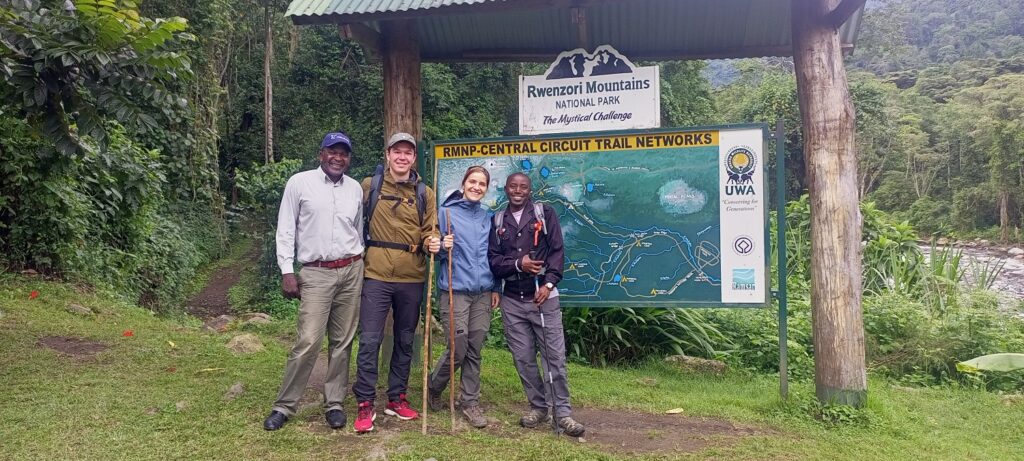
Gaiters are non-negotiable. The Central Circuit’s trail surface is largely bog, mud, and waterlogged plant matter, and without gaiters, your boots and lower legs will be wet within the first hour and will remain wet for the duration of the trek. Full-length gaiters, not the short trail-running variety, are what the Rwenzori demands. Trekking poles are strongly recommended for balance on the steep, slippery descents that characterize much of the route between camps.
The Kilembe Trail
The Kilembe Trail approaches the Rwenzori from the south, entering through the Kilembe Valley and offering a distinct perspective on the range with excellent summit views and a less-trafficked trail experience. Like the Central Circuit, the Kilembe Trail is non-technical in the mountaineering sense; crampons and ropes are not part of the standard itinerary. The terrain is, if anything, even more demanding than the Central Circuit in the lower sections, with steep bamboo-zone gradients and dense vegetation requiring careful foot placement and sustained use of trekking poles.
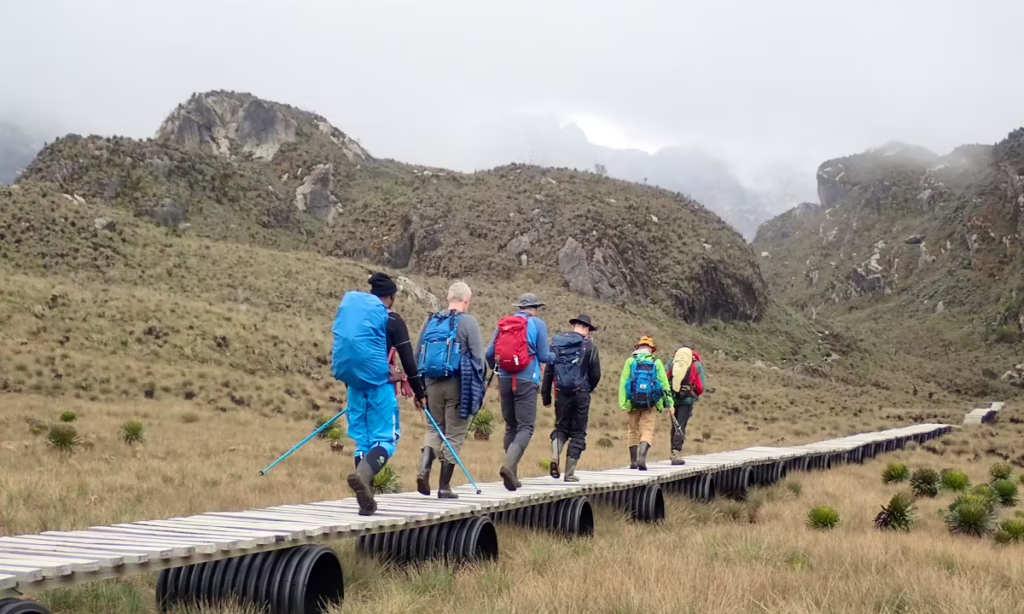
The Kilembe Trail reaches similar maximum altitudes to the Central Circuit on standard itineraries, keeping trekkers below the permanent snow line. The equipment priorities here mirror those of the Central Circuit: waterproof boots, full gaiters, waterproof outerwear, and warm layering for the upper camps. The trail’s remoteness, which sees fewer trekkers than the Central Circuit, means that being well-equipped is even more important, as the margin for gear failure is smaller.
The Mahoma Loop and Bukulungu Trail
The Mahoma Loop and Bukulungu Trail are lower-altitude routes that remain well within the non-technical zone of the Rwenzori. The Mahoma Loop, a two-to-three-day circular route through the montane forest and lower moorland, reaches maximum altitudes well below 3,000 meters and is entirely suited to general trekking equipment. The Bukulungu Trail similarly operates within the lower forest and moorland zones. Neither route requires nor benefits from crampons, ice axes, or technical rope equipment. Strong waterproof boots, gaiters, and good rain gear are the essential items for both.
Technical Routes: When Crampons and Ropes Become Essential
Margherita Peak: The Full Technical Picture
Everything changes when the objective is Margherita Peak. At 5,109 meters, Margherita is the highest point in Uganda, the highest point in the Rwenzori range, and the third-highest peak in Africa. It sits on the border of Uganda and the DRC, at the apex of Mount Stanley’s twin summit massif, and reaching it requires crossing permanent glacial terrain that demands full technical mountaineering equipment and the skills to use it.
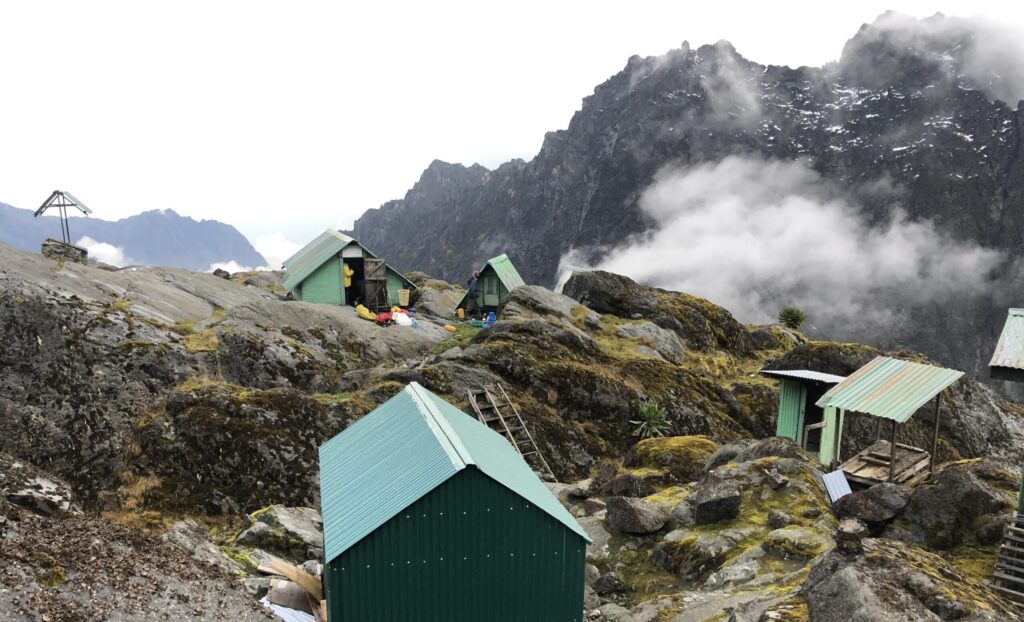
Elena Hut
The standard approach to Margherita from the Ugandan side involves ascending through the upper snowfields above Elena Hut, crossing the Stanley Plateau glacier, and making the final push to the summit over mixed snow and rock. The glacier is genuine high-alpine terrain: crevassed in places, steep in sections, and dependent on current conditions for the specific route taken. On this terrain, crampons are not optional safety extras; they are the fundamental tool that makes safe movement possible. A trekker on glacial ice without crampons is not underprepared; they are genuinely dangerous to themselves and to others in the team because the lack of proper traction can lead to slips, falls, and potentially life-threatening accidents in such challenging conditions.
The crampon requirement for Margherita is for full 12-point technical crampons compatible with semi-rigid or rigid mountaineering boots. Trail running crampons, microspikes, or the lightweight traction devices sometimes used on icy hiking trails are inadequate for the Rwenzori glacier terrain. You need step-in or hybrid binding crampons that mount securely to a boot with a welt or a binding-compatible sole. Flexible hiking boots cannot be safely fitted with technical crampons, making them unsuitable for the Margherita summit push.
Ice Axe: The Non-Negotiable Summit Tool
Alongside crampons, an ice axe is required equipment for the Margherita summit attempt. The ice axe serves two critical functions on the Rwenzori glaciers: as a balance and movement tool on steep snow and as the primary self-arrest device in the event of a slip. The Stanley Plateau has sections of sustained 30-to-40-degree snow slope where a fall without self-arrest capability could have serious consequences. Our guides carry ice axes as standard on all summit routes, and all trekkers in our Margherita groups are provided with ice axes and receive a pre-summit briefing on basic crampon and ice axe technique before the summit push.

Trekkers who have prior alpine experience and their own technical equipment are welcome to bring it; a well-fitted, personally owned crampon-axe setup is always preferable to rented equipment that a trekker has never used before. Trekkers without prior technical experience should be candid about this when they contact us. Our guides are skilled at providing the level of hands-on instruction needed to get a capable, fit, motivated trekker safely to Margherita, but there is a baseline of physical confidence and movement ability that cannot be compressed into a single pre-summit briefing.
Ropes on the Rwenzori: Fixed Lines, Team Roping, and Glacier Travel
Fixed ropes are installed on some sections of the upper Margherita route, particularly on the steeper rock and ice sections approaching the summit ridge, and these are used by all trekkers and guides on the route. You do not need to bring your ropes for the standard Margherita summit approach on our guided trips. Experienced local guides maintain the fixed-line infrastructure, which serves as the primary safety backup on the most exposed terrain.
Team roping, the technique of connecting trekkers to each other and to the guide via a shared rope, is used on the glacier crossing sections of the Stanley Plateau, where crevasse risk is present. This is standard alpine practice and something our guides set up and manage as part of the summit day procedure. Trekkers do not need to know advanced rope techniques for this; they need to follow their guide’s instructions, move deliberately, and maintain appropriate spacing and tension on the rope. This aspect is explained and practiced before the glacier crossing begins.

For trekkers targeting not just Margherita but multi-peak expeditions across Mount Speke, Mount Baker, and the range’s other glaciated summits, the technical rope and crampon requirements remain consistent across the upper alpine zones. Each summit has its approach characteristics; Mount Speke’s Vittorio Emanuele Peak involves a different line than Margherita, for instance, but the fundamental toolkit of technical crampons, ice axe, and rope competence applies across all of the glaciated peaks. Our team can advise on the specific requirements for each peak when you explore our full treks overview.
Helmets, Harnesses and Other Technical Equipment
Beyond crampons, ice axes, and rope, trekkers targeting Margherita and the other glaciated Rwenzori summits should be prepared for two additional pieces of technical equipment: a climbing helmet and a harness.

A helmet is required on the upper summit routes. The Rwenzori’s upper terrain includes sections of loose rock and mixed scrambling where rockfall from above or dislodged by the trekker themselves or their rope team is a genuine hazard. This threat is not theoretical. The summit day on Margherita involves sections of exposed rock climbing where a helmet is not a precaution but a basic requirement. A lightweight alpine or rock climbing helmet is appropriate; a bicycle or ski helmet is not. Our team can advise you on suitable helmet models and, in some cases, provide rental helmets; please ask us when you book.
A sit harness is required for the roped glacier crossing sections and for the use of fixed lines on the upper summit approaches. Again, this does not require advanced climbing skill on the trekker’s part, but it does require a correctly fitted harness that the trekker can put on and check independently. If you have your harness from previous climbing experience, bring it. If you do not, our team will ensure you have access to appropriate equipment before the summit day and will verify fit before you leave camp.
Boots: The Most Important Equipment Decision You Will Make
Across every Rwenzori route, technical or non-technical, boot selection is the equipment decision that most influences the quality and safety of your experience. The Rwenzori is uniquely demanding on footwear: the persistent wetness of the lower zones puts continuous pressure on waterproofing, while the steep, sometimes icy upper terrain requires structural rigidity and crampon compatibility for summit routes.
For non-technical routes, including some parts of the Central Circuit and the Kilembe Trail, the ideal boot is a mid-to-heavyweight waterproof hiking boot with full ankle support, a Vibram-style lug sole for grip on wet roots and mud, and a proven waterproof membrane. Gore-Tex lining is the benchmark. The boot does not need to be crampon-compatible, but it must be genuinely waterproof (not water-resistant) and properly broken in before you arrive in Uganda. Arriving at Nyakalengija with new, unbroken boots is one of the most common and painful mistakes first-time Rwenzori trekkers make.

For Margherita and other technical summit routes, the footwear requirement steps up significantly. You need a semi-rigid or rigid mountaineering boot that accepts technical 12-point crampons. The classic mountaineering boot in this category, a B2 or B3 rated boot in the European standard, provides the sole stiffness needed for front-pointing on ice and the ankle immobilization needed for descending steep snow in crampons. These boots are also warmer than standard trekking boots, which is significant at higher altitude bivouacs. They are not comfortable on the lower forest trails, which is why many trekkers on summit itineraries carry two pairs of boots: standard trekking boots for the lower approach sections and technical boots for the upper mountain.
What Your Guide Provides Versus What You Must Bring
This is one of the most practical questions we receive from prospective trekkers, and it deserves a direct answer. On all Rwenzori Trekking Safaris guided treks, your guide provides comprehensive route knowledge and navigation; daily weather assessment and safety monitoring; altitude sickness monitoring using pulse oximeters and the Lake Louise Score protocol; a full emergency medical kit; communication devices; and all the fixed rope infrastructure on technical summit routes. For summit routes, our guides also carry supplemental oxygen, and the guide-to-trekker ratio on technical routes ensures close supervision throughout.
What trekkers must provide for themselves: all personal footwear (boots appropriate to the route), all personal waterproof outerwear, all personal thermal and mid-layers, personal trekking poles, personal gaiters, a sleeping bag appropriate to the altitude, and for technical routes, personal technical equipment including crampons, an ice axe, a harness, and a helmet. We are transparent about this because the temptation to cut corners on personal equipment is real, and the consequences of underprepared personal gear on the Rwenzori are disproportionately serious.
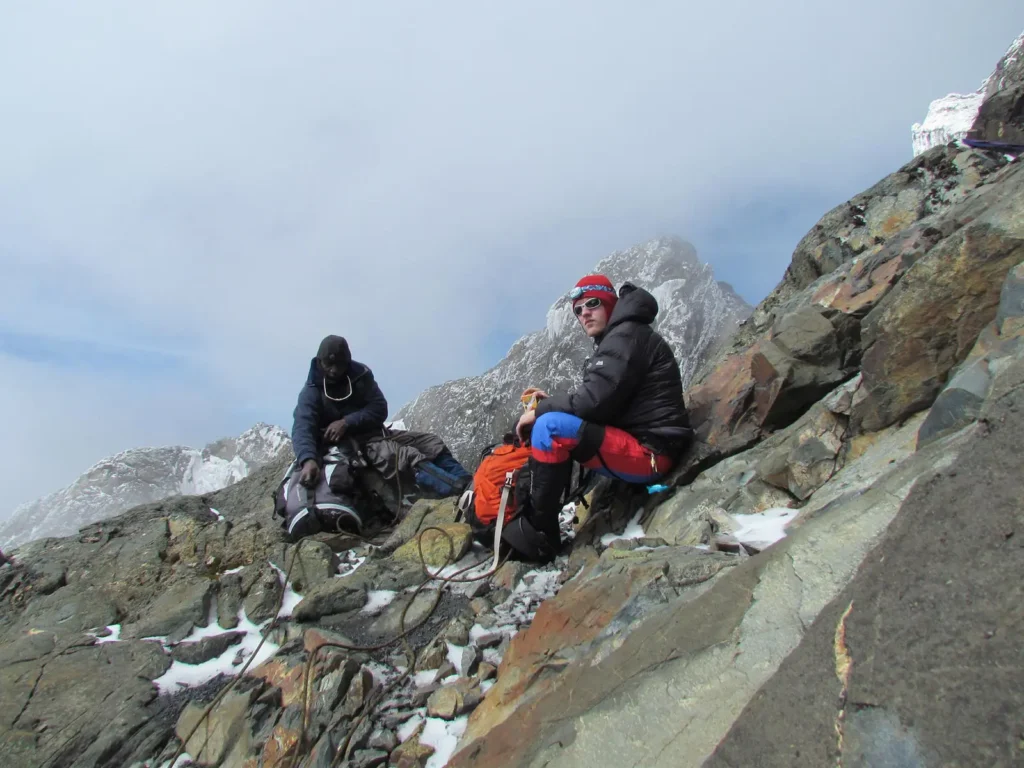
We do maintain a limited rental equipment pool for technical items (crampons, ice axes, helmets, and harnesses), which is available to trekkers who do not own their gear. Rental equipment is inspected and maintained to our own safety standards before each use. However, we strongly encourage trekkers to use equipment they have prior experience with wherever possible, and we always recommend that rental equipment be tested for fit and function before departure day.
Contact us via our contact page to discuss rental availability for your specific dates and route.
Prior Experience and Skill: How Much Do You Need?
Technical equipment without the skill to use it confidently is not a safety measure; it is a false comfort. We are honest about this because it matters. The question of whether you need crampons and ropes on the Rwenzori is partly an equipment question, but it is equally a skill and experience question.
For non-technical routes, the skill requirement is standard multi-day trekking fitness and competence. You need to be comfortable with sustained uphill and downhill movement over several consecutive days, be willing to move in wet and cold conditions, and be honest with yourself and your guide about your physical state at altitude. These are the skills that matter on the Central Circuit and the Kilembe Trail. No technical mountaineering background is required or expected.
For the Margherita summit, prior experience with crampons on snow or ice and prior experience moving on roped glacier terrain are strongly recommended. It does not need to be extensive; a single winter alpine course or a previous ascent on a glaciated peak, such as Kilimanjaro’s Breach Wall route or a standard alpine route in the Alps or Rockies, provides the baseline. Trekkers with no prior crampon or glacier experience who are determined to attempt Margherita should discuss their intentions candidly with us before booking. We can advise on preparatory courses in your home country and design an itinerary with sufficient practice time built into the lower mountain sections.
The Glacier Question: How Much Snow and Ice Is Left on the Rwenzori?
Any honest guide writing about the Rwenzori in 2026 has to acknowledge a fact that is both scientifically documented and visually obvious to anyone who has stood on the Stanley Plateau and looked at old expedition photographs: the Rwenzori glaciers are retreating. The ice fields that once covered the upper reaches of Mounts Stanley, Speke, and Baker have shrunk dramatically over the past century, and the rate of retreat has accelerated in recent decades under the influence of climate change. This decline is not a distant risk; it is a present reality that shapes the technical character of the upper mountain.

What this means practically is that the extent of glaciated terrain requiring crampons on the Margherita route varies from season to season and year to year. There are summit seasons where the Stanley Plateau presents classic glacier travel over substantial snowfields, and there are seasons increasingly common where significant sections of the approach involve more mixed rock and ice than pure glacier walking. Our guides assess current conditions before every summit departure and adjust equipment requirements accordingly. There are seasons where crampons are needed for only a portion of the upper mountain and seasons where they are required from the moment you leave Elena Hut.
The practical upshot is that all trekkers on Margherita itineraries should arrive with technical crampons and an ice axe regardless of what they have read about recent conditions. The cost of carrying technical equipment you do not ultimately use is negligible. The cost of arriving without it in a season when the glacier demands it is not a risk worth taking.
Frequently Asked Questions: Crampons, Ropes and Technical Gear for the Rwenzori
Do I need crampons for the Rwenzori Mountains?
Crampons are required for trekkers targeting Margherita Peak (5,109 m) and other glaciated summits on Mounts Stanley, Speke, and Baker, where permanent snowfields and glacier crossings make technical traction essential. For all other standard Rwenzori routes, including the Central Circuit Trail, the Kilembe Trail, the Bukulungu Trail, and the Mahoma Loop, crampons are not required, as these routes remain below the permanent snow line and do not involve technical glaciated terrain.
When in doubt about whether your specific itinerary requires crampons, contact us directly, and we will confirm based on your exact route and current mountain conditions.
Do I need ropes for trekking the Rwenzori?
Ropes are used on the technical summit routes to Margherita Peak and the other glaciated Rwenzori summits, specifically for glacier crossing sections where crevasse risk is present and for the use of fixed lines on exposed summit approaches. For all non-technical routes, the Central Circuit, Kilembe Trail, Mahoma Loop, and Bukulungu Trail ropes are unnecessary. On our guided summit itineraries, the guide team manages all roped sections and provides fixed-line infrastructure; trekkers need a harness but do not need to bring their ropes.
What technical mountaineering experience do I need for Margherita Peak?
We recommend that trekkers targeting Margherita Peak have prior experience with crampons on snow or ice terrain and some exposure to roped glacier travel before the summit day. A single alpine skills course, or a previous ascent of a glaciated peak at a comparable altitude, provides a solid baseline. Trekkers with no prior technical experience are not automatically excluded, but they should discuss their background candidly with us before booking so that we can advise on preparatory training and build appropriate practice time into the itinerary. Physical fitness and altitude experience are equally important prerequisites alongside technical skill.
What type of crampons do I need for the Rwenzori?
The Margherita summit route requires full 12-point technical crampons, which are specialized traction devices with 12 points for climbing on ice and snow, compatible with a semi-rigid or rigid mountaineering boot, a B2 or B3 rated boot in the European standard. Microspikes, trail crampons, or lightweight traction devices are inadequate for the Rwenzori’s glacier terrain and will not be accepted as substitutes on our summit departures. The crampon must attach securely to a boot with a rigid sole or binding welt; flexible hiking boots are incompatible with technical crampons and are not suitable for the Margherita summit push.
Do I need an ice axe for the Rwenzori?
Yes, an ice axe is required equipment for Margherita Peak and all other glaciated Rwenzori summits. The ice axe is used both as a movement tool on steep snow and as the primary self-arrest device in the event of a slip on the upper snowfields. The standard tool for this terrain is a walking or general mountaineering ice axe of appropriate length for the user’s height, typically between 60 and 70 cm. Technical or specialist ice tools designed for vertical ice climbing are not necessary, as the standard walking or general mountaineering ice axe is sufficient for the conditions encountered in the Rwenzori. Our guides carry ice axes on all summit itineraries, and rental axes are available through our team for trekkers who do not own one.
What boots should I bring for the Rwenzori?
For non-technical routes, including the Central Circuit and the Kilembe Trail, a waterproof mid-to-heavyweight hiking boot with full ankle support and a Vibram-style lug sole is ideal. The boot must have a genuine waterproof membrane (Gore-Tex or equivalent), and it must be properly broken in before arrival. For Margherita Peak and other glaciated summits, a semi-rigid or rigid mountaineering boot compatible with 12-point technical crampons is required. Many trekkers on summit itineraries bring two pairs of boots: standard trekking boots for the lower mountain and technical mountaineering boots for the upper sections.
Does the guide provide crampons and ropes, or must I bring my own?
Our guides provide fixed rope infrastructure on all technical summit routes and manage all team roping on glacier crossings; you do not need to bring your rope. For personal technical equipment, including crampons, ice axes, harnesses, and helmets, the expectation is that trekkers bring their own or use our rental equipment pool. We maintain a rental inventory for technical items that is available to trekkers without their gear, subject to availability and size suitability.
Contact us well in advance of your trek to confirm rental availability, and always arrange a fitting session before departure day.
Is a helmet required for the Rwenzori summit routes?
Yes, a climbing helmet is required for Margherita Peak and the other glaciated summit routes on the upper Rwenzori. The upper terrain includes sections of loose rock, mixed climbing, and exposed ridgelines where rockfall risk from above or dislodged by the team itself is real. A lightweight alpine or rock climbing helmet is appropriate; bicycle or ski helmets are not suitable substitutes. Helmets are available through our rental equipment pool for trekkers who do not own one, and we verify helmet fit before the summit day departure.
How much has glacial retreat affected the need for crampons on the Rwenzori?
Glacial retreat has reduced the total extent of permanently glaciated terrain on the upper Rwenzori, meaning that some sections of the Margherita approach that formerly involved pure glacier travel now involve more mixed rock and ice. However, permanent glaciers remain on the Stanley Plateau and the upper Margherita approach route, and crampons and ice axes remain essential equipment for the summit. The proportion of glaciated versus mixed terrain varies seasonally and year to year, which is why our guides assess current conditions before every summit departure. Trekkers should always arrive with full technical equipment regardless of what recent reports suggest about conditions.
Can I rent crampons and technical gear at the Rwenzori trailhead?
Technical equipment rental is available through Rwenzori Trekking Safaris and should be arranged in advance through our booking process rather than assumed to be available at the trailhead on arrival. We curate a rental inventory of technical crampons, ice axes, helmets, and harnesses, inspecting and maintaining them to our own safety standards. Rental equipment availability is subject to size matching and prior booking, and we cannot guarantee availability for walk-in requests. We strongly encourage trekkers to use equipment they are familiar with wherever possible and to arrange any rental requirements at least four to six weeks before their departure date.
Start Planning Your Rwenzori Trek Today
The Rwenzori Mountains are one of the world’s outstanding trekking destinations, a UNESCO World Heritage site of extraordinary biological richness, surreal landscapes, and genuine high-altitude challenge. Whether your objective is the forest and moorland experience of the Central Circuit, the remote wilderness of the Kilembe approach, or the full technical achievement of standing on Margherita Peak at 5,109 meters, the right preparation and the right team make the difference between a safe, joyful experience and a difficult one.

Our team at Rwenzori Trekking Safaris has guided trekkers of all backgrounds and experience levels across every route and every summit this range has to offer. We will provide you with honest, specific, experience-based advice on exactly what equipment you need for your chosen itinerary, no upselling, no vagueness, and no generic checklists lifted from a different mountain. When you reach out to us, you receive direct guidance from guides who have recently traversed these trails.
📩 Reach us via our website contact form or connect with us directly on WhatsApp for a fast, personal response. Please share your summit goals, experience level, and preferred dates with us, and we will handle the rest. The Mountains of the Moon are waiting.


